PYP Curriculum

The IB Primary Years Programme (PYP) for 3-12 year-olds focuses on the growth of the developing child, and addresses social, physical, emotional, cultural and academic development. This programme was designed and written by international educators,  combining the best research and practice from a range of national systems with a wealth of knowledge and experience from international schools. The result was a significant, relevant, challenging and engaging educational programme that is being implemented by an ever-increasing number of international and national schools across the world.  

The IB also offers the Middle Years Programme for 11-16 year-olds, the Diploma Programme for the 16-19 year-olds and the Career-Related Programme, also for 16-19 year-olds who wish to engage in career-related learning. Together, the four programmes form a coherent sequence of international education emphasising intellectual, personal, emotional and social growth. Exposure to the PYP serves as an excellent preparation for Middle Years or Diploma Programmes since the IB learner profile, approaches  to learning and philosophy are consistent throughout.  

To gain a deeper understanding of the relationship between the International Baccalaureate, students and the learning community, please refer to the General Regulations and the Standards and Practices on the IB website: www.ibo.org

Inquiry in the PYP

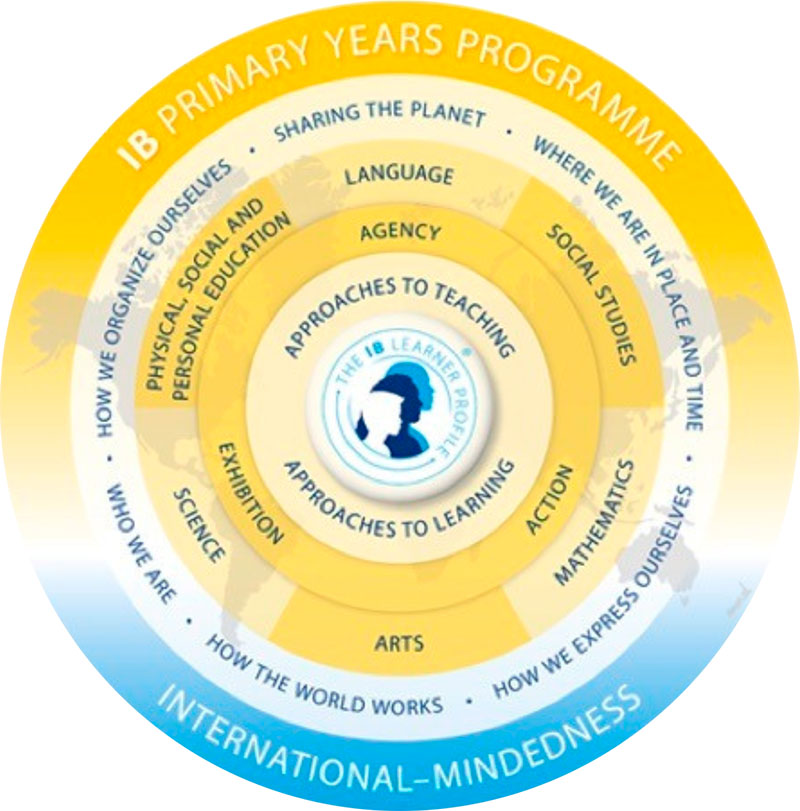
The PYP is an inquiry-led, transdisciplinary framework for education, focusing on the whole child as an inquirer. The PYP nurtures academic, social and emotional wellbeing alongside independent learning skills in order to foster agency. The internationally-designed model in learning considers the learner, learning and teaching and the learning community within its framework. These pillars are what underpins the practices with the intent of creating internationally-minded citizens. 

Using the learner profile attributes encourages learners to develop as responsible and active members of the community.  The learner profile is actively used throughout the school as it was noted in the last PYP Evaluation Report in January, 2023.

 “Caring, respectful and effective communication among and between staff and students demonstrates the commitment of the school community members to the IB learner profile. Classroom observations and meetings with students and teachers show that there is a caring environment that supports all members of the learning community.”

Inquiry in the PYP

The IB learner profile represents 10 attributes valued by IB World Schools. We believe these attributes, and others like them, can help individuals and groups become responsible members of local, national and global communities. As IB learners we strive to be:

We nurture our curiosity, developing skills for inquiry and research. We know how to learn independently and with others. We learn with enthusiasm and sustain our love of learning throughout life.

We use critical and creative thinking skills to analyse and take responsible action on complex problems. We exercise initiative in making reasoned, ethical decisions.

We develop and use conceptual understanding, exploring knowledge across a range of disciplines. We engage with issues and ideas that have local and global significance.

We approach uncertainty with forethought and determination; we work independently and cooperatively to explore new ideas and innovative strategies. We are resourceful and resilient in the face of challenges and change.

We act with integrity and honesty, with a strong sense of fairness and justice, and with respect for the dignity and rights of people everywhere. We take responsibility for our actions and their consequences.

We critically appreciate our own cultures and personal histories, as well as the values and traditions of others. We seek and evaluate a range of points of view, and we are willing to grow from the experience.

We show empathy, compassion and respect. We have a commitment to service, and we act to make a positive difference in the lives of others and in the world around us. 

We express ourselves confidently and creatively in more than one language and in many ways. We collaborate effectively, listening carefully to the perspectives of other individuals and groups. 

We understand the importance of balancing different aspects of our lives—intellectual, physical and emotional—to achieve well-being for ourselves and others. We recognise our interdependence with other people and with the world in which we live. 

We thoughtfully consider the world and our own ideas and experience. We work to understand our strengths and weaknesses in order to support our learning and personal development.

KNOWLEDGE

Learning and Teaching

A transdisciplinary approach to learning is a fundamental PYP belief.  For all learners, a continuous integration and connection of prior and new knowledge and experiences is the most meaningful way to broaden understanding about the world. Through this approach, learning is not confined within the boundaries of traditional subjects but is supported and enriched by them. Disciplines that can be embedded into transdisciplinary learning include: language, mathematics, science, Personal, Social and Physical Education (PSPE) and the arts.

This open source resource here may be helpful for you as you become familiar with PYP terms and vocabulary. 

Transdisciplinary Themes  

Academic subjects are often embedded into transdisciplinary themes set by the IB.  These globally- and socially-driven themes provide a starting point from which students explore issues and examine opportunities as they are being experienced in the real world, providing authentic learning engagements and framing the Programme of Inquiry. 

There are six transdisciplinary themes that are followed in all IB PYP schools and across every age group, with the exception of the Early Years (four units) and Group 2 (five units).

An inquiry into the nature of the self; beliefs and values; personal, physical, mental, social and spiritual health; human relationships including families, friends, communities, and cultures; rights and responsibilities; what it means to be human. 

An inquiry into the natural world and its laws; the interaction between the natural world (physical and biological) and human societies; how humans use their understanding of scientific principles; the impact of scientific and technological advances on society and on the environment. 

An inquiry into the ways in which we discover and express ideas, feelings, nature, culture, beliefs and values; the ways in which we reflect on, extend and enjoy our creativity; our appreciation of the aesthetic. 

An inquiry into the interconnectedness of human-made systems and communities; the structure and function of organisations; societal decision-making; economic activities and their impact on humankind and the environment. 

An inquiry into orientation in place and time; personal histories; homes and journeys; the discoveries, explorations and migrations of humankind; the relationships between and the interconnectedness of individuals and civilisations, from local and global perspectives. 

An inquiry into rights and responsibilities in the struggle to share finite resources with other people and with other living things; communities and the relationships within and between them; access to equal opportunities; peace and conflict resolution. 

Concepts

Concepts are formed as questions which allow learners to form connections between different areas of learning. Using the IB Related concepts; form, function, connection, causation, change, perspective, responsibility, the learners deepen their understanding.  They then move from factual-based understandings to transfer knowledge, and form connections to other areas of learning.  Exploring concepts can also support learners to think more critically, recognise patterns and transfer knowledge to different contexts.  

Concept-driven inquiry is a powerful vehicle for learning as it promotes meaningful understanding and challenges students to engage with significant ideas. As conceptual understandings are broad abstract ideas, these can either be transdisciplinary or subject based. Through various Approaches to Learning (AtL), which are implicitly and explicitly taught throughout the year groups, students begin to co-construct beliefs and understandings, supporting them to become more agentic learners. 

Although learning is conceptually-driven, language and mathematics are regarded as essential elements of all inquiry. Their importance has not been devalued but their role has been given greater relevance by connecting them to areas of inquiry in a meaningful way to further understanding and application, in real-world contexts. Their role in the units of inquiry is to facilitate inquiry through language or mathematics. However, some elements of mathematics (e.g. place value) and language (e.g. handwriting, spelling) fall outside the Programme of Inquiry, as certain skills need to be introduced and learned in isolation. These specific skills can be, and are, taught  through stand-alone units and lessons.  

The Learning Community

As an IB school we value relationships, which will affect learning and seek to benefit all stakeholders involved. The learning community focuses on developing peaceful and constructive relationships between students and peers, students and teachers, teachers and colleagues as well as school and family.  As an IB school we are committed to promoting international mindedness and are committed to fostering a caring and inclusive community for everyone involved in the school.  

Here what some members of learning community have to say:

“A professional and friendly school where I can grow as a teacher and individual. I have found a school that works hard to be better, and it does quickly and effectively. I feel valued, safe, and challenged without the negative aspect of being stressed. I also see the kids growing as individuals and with a sense of community, and collaboration and thinking skills I’ve never seen in my previous schools. I totally recommend IPS and the IB to teachers and families. It is never boring learning here!”

Rosa Alonso, Class Teacher 

“Empowering and inspiring all students to excel as lifelong learners.”

Abhineet, Group 8 student

“IPS is awesome and fun!”

Vedanshi, Hugo, Mira and Arneet, Group 3 students

The Approaches to Learning, AtL Skills

Approaches to Learning (AtL) are skills embedded throughout the learning process that can be applied in different contexts.  The five categories are; thinking skills, research skills, communication skills, social skills and self management skills.  These essential skills support students in becoming lifelong learners who understand how to learn.

  • Critical-thinking skills (analysing and evaluating issues and ideas)
  • Creative-thinking skills (generating novel ideas and considering new perspectives)
  • Transfer skills (using skills and knowledge in multiple contexts)
  • Reflection/metacognitive skills ((re)considering the process of learning)
  • Information-literacy skills (formulating and planning, data gathering and recording, synthesizing and interpreting, evaluating and communicating)
  • Media-literacy skills (interacting with media to use and create ideas and information)
  • Ethical use of media/information (understanding and applying social and ethical technology)
  • Exchanging-information skills (listening, interpreting, speaking)
  • Literacy skills (reading, writing and using language to gather and communicate information)
  • ICT skills (using technology to gather, investigate and communicate information)
  • Developing positive interpersonal relationships and collaboration skills (using self-control, managing setbacks, supporting peers)
  • Developing social-emotional intelligence
  • Organisation skills (managing time and tasks effectively)
  • States of mind (mindfulness, perseverance, emotional management, self-motivation, resilience)

Action

Action is at the heart of agency, and is central to the PYP).  Through taking action, students come to see the importance of being internationally-minded, taking responsibility and working with others for a shared purpose.  Students come to see themselves as independent and capable learners who are able to instil and inspire change. Initiated by students, PYP action is meaningful and relevant for the learner. In accordance with the IB it is explained that action can be:

  • a change in attitude
  • a consideration or plan for action in the future
  • a demonstration of responsibility, or of respect for self, others and the environment
  • a commitment to leading or participating in a youth advocacy group
  • an engagement in school decision-making or an expression of support in community, local and global decision-making.

The 5 parts essential elements of action defined by the IB are:

PYP Exhibition

In Group 8, the Exhibition is a culminating, collaborative experience and demonstrates an authentic process in which students have explored, documented and shared their understanding of an issue or opportunity of personal significance. Exhibitions are student-led and designed so that learners take an active role in all aspects of planning, inquiring, investigating, communicating and assessing their own learning. The purpose behind the Exhibition is for students to engage in an in-depth collaborative inquiry that demonstrates the dispositions from the learner profile and utilises the approaches to learning taught throughout their PYP experience.

Inclusion

The Student Support Team (SST) strives to offer all students the necessary support and resources to enable them to learn and develop within our programme. IPS embraces the philosophy of the IB in that “inclusion is an ongoing process that aims to increase access and engagement in learning for all students by identifying and removing barriers.” (Learning Diversity and Inclusion in IB Programmes 2016).

SST works in partnership with the class teachers to assess the learning needs of the students and plan and organise the relevant support. The team assists students with a range of needs and learning differences. English as an Additional Language (EAL) is offered to students after Group 2, who have little or no English language skills. This specific type of support is provided by a specialist language teacher.

Support is offered on an individual basis or in a small group setting both in and out of class. Goals and strategies put in place are evaluated and adjusted in collaboration with the classroom teacher. The programme aims to establish communication, security and progress for the student in order to ensure equitable access to the curriculum.

Home and Family Languages

The PYP supports the use of home and family languages in school. These languages form an integral part of the learning landscape that shapes our school and the learning community. Students are encouraged to draw from their prior linguistic knowledge to help them find similarities and differences between their own languages and the language of instruction (English).  Students are encouraged to continue reading in their home language, and the school library carries books in many languages.

Host Country Language (HCL)

Dutch, as the HCL, is offered to students throughout the school.  The aim of the programme is to connect and understand the language and culture of the host country through both small group and whole class settings.

Dutch in the lower years engages students through play-based learning taught by native Dutch speakers. Students are introduced to the Dutch language and culture through songs, drama, role play, art and games.

As students progress, they inquire into understandings of Dutch culture and language. Emphasis is first placed on developing age-appropriate language skills for speaking and listening skills, with a development of reading and writing depending on the student’s level of understanding.

Teaching Assistants

The teaching staff are supported by a dedicated team of Teaching Assistants (TAs). Working with the youngest students, our passionate and enthusiastic TAs support learners settling into the school routine, and help them to become independent thinkers and inquirers. They work alongside teachers everyday to enhance the learning environment and activities in and outside of the classroom.  

Music

Music takes place once a week in class and is delivered by a music specialist. The teacher designs and delivers engaging lessons based on playing and experimentation. Students inquire into different areas of music, such as voice and instrumental performance, music theory and understanding of local and world music. This is all contextualised within the IB curriculum in order to support and work together with the other subjects.

PE

Physical Education takes place twice a week, and lessons are given by class teachers as well as a subject specialist.  The themes of Fitness Challenges, Movement, Games, Compositions and Individual Pursuits are used so that students are exposed to a wide range of physical activities.  In PE lessons, students continue to develop learner profile attributes as well as making cross curricular connections to other areas of their learning.

After-school Dutch lessons are provided by external teachers, and information about these lessons, including pre-testing and costs, is shared with parents after the start of the school year.

The library is central to learning in a PYP school. Both school locations house a well-stocked school library, which students and teachers make use of throughout the year. All students have scheduled time in the library and change their books regularly, finding new books to support their love of learning.

57

As a school we complete more than 57 units of inquiries per year

1.95million

Do you know that the IB offers four educational programmes to more than 1.95 million students globally, aged 3-19?

1986

IPS Hilversum started as an International Department of the Violenschool in 1986

20

In June 2006, to commemorate its 20 years of existence, the governing body of the Violenschool officially renamed the Violenschool International Department to Violenschool International Primary School

46

Families in our community speak 46 different languages at home